Balinese art is everywhere. You’ll find it carved into temples, hanging in galleries, stacked inside roadside workshops and decorating homes, hotels and restaurants across the island.
But there’s far more to Balinese art than something colourful to take home from your holiday. Traditional paintings tell stories drawn from Hindu mythology and everyday life, while generations of local and Western artists have introduced new techniques and styles without completely abandoning Bali’s artistic roots.
From traditional Balinese paintings and intricate wood carvings to modern art, sculpture and silversmithing, here’s our comprehensive guide to the art of Bali.
TL;DR: Summary Of Balinese Art
- Balinese art is deeply connected to the island’s religion, culture and everyday life.
- Traditional painting developed into distinctive styles including Kamasan, Ubud, Batuan, Sanur and Keliki.
- Western artists including Walter Spies, Rudolf Bonnet and Arie Smit helped influence the evolution of modern Balinese art.
- Balinese art can be seen across the island in galleries, museums, temples, workshops and everyday settings.
The History Of Balinese Art
Art has been part of Balinese life for centuries, although traditionally there was little distinction between art, religion and everyday life. Painters, sculptors and other artisans created work for temples, palaces and ceremonies rather than exhibitions or private collections.
Early Balinese art was strongly influenced by Hindu-Javanese culture, particularly after the decline of the Majapahit Empire brought artists and craftsmen from Java to Bali. Religious stories, mythology and scenes from Hindu epics became recurring subjects, many of which remain visible in art today.
Traditional Balinese Paintings
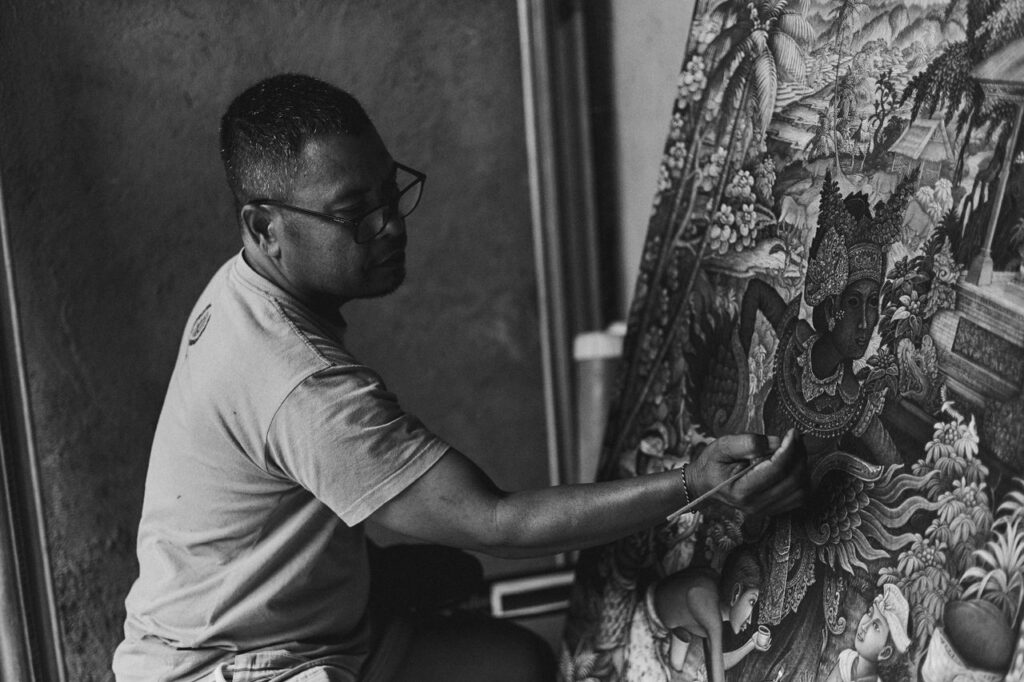
Traditional Balinese paintings were created primarily to decorate temples and royal buildings or illustrate religious stories. Rather than focusing on individual expression, painters followed established styles and conventions passed between generations.
Many works depict crowded scenes from Hindu-Javanese epics such as the Ramayana and Mahabharata, filled with gods, demons, royalty and mythical creatures. Early artists worked with natural dyes and pigments on cloth or bark before canvas and other new materials became widely available.
Kamasan And Wayang Style
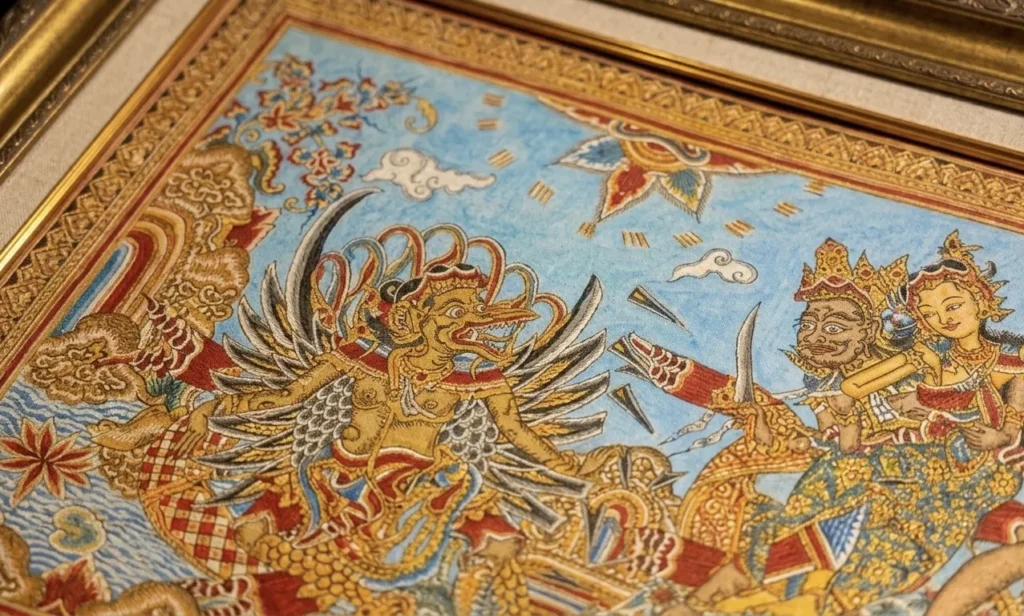
One of the oldest surviving forms of Balinese painting comes from Kamasan, a village in East Bali that became an important centre for traditional artists.
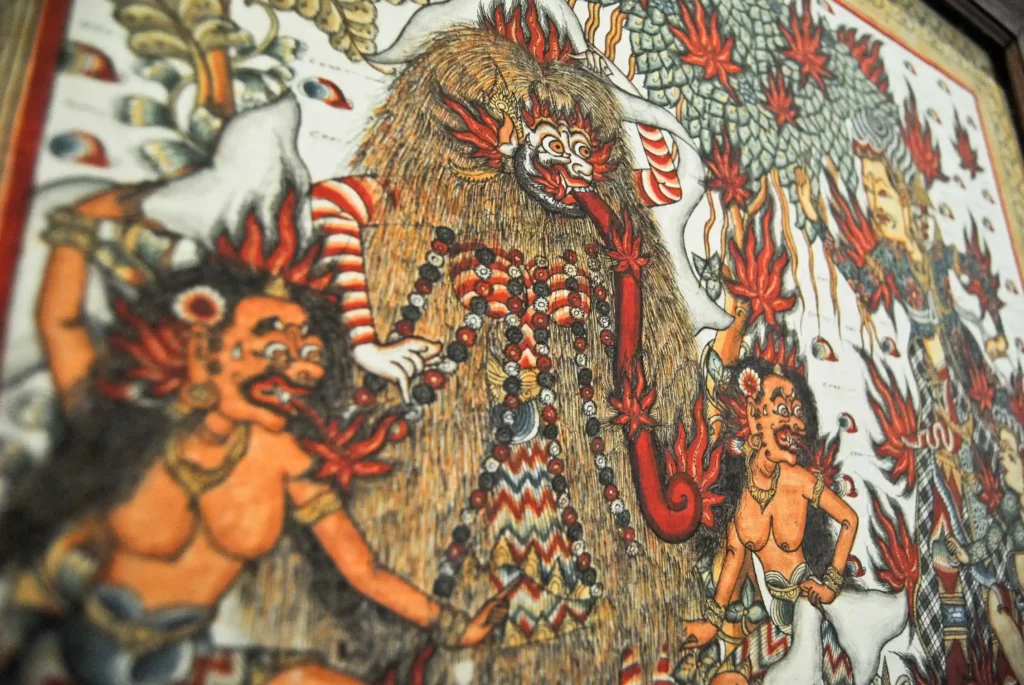
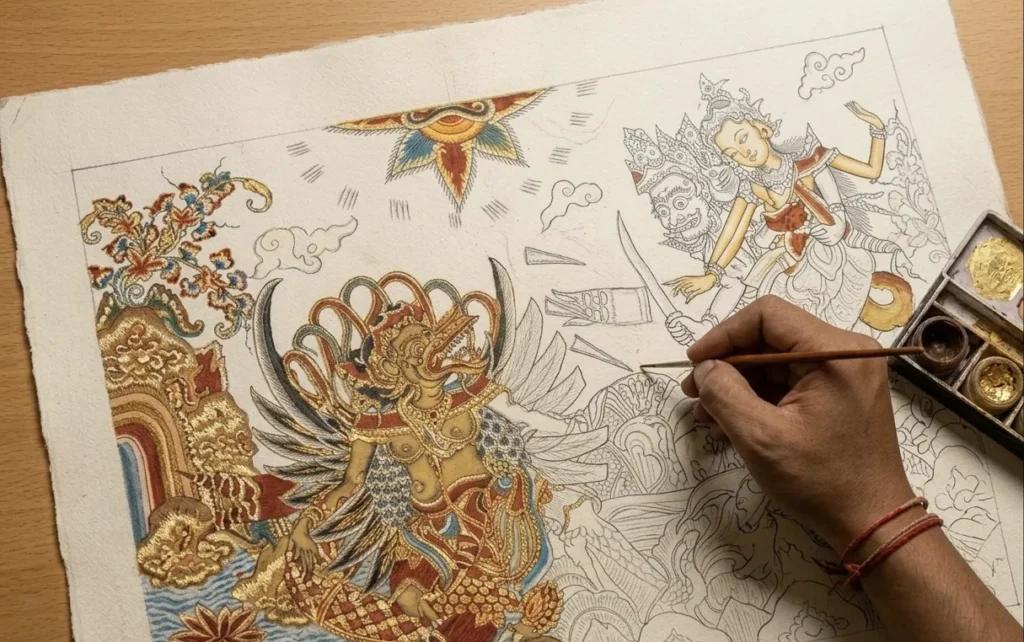
Known as the Kamasan or Wayang, these paintings resemble the figures seen in traditional shadow puppetry. Characters are carefully arranged according to their importance, with stories usually drawn from Hindu mythology and epic tales.
The style is instantly recognisable for its flat figures, intricate outlines and limited palette traditionally created using natural dyes. Kamasan artists continue the tradition today, making it one of Bali’s most enduring forms of folk art.
Western Artists And The Transformation Of Balinese Painting
Balinese painting changed considerably during the early 20th century as many Western artists began settling on the island, particularly around Ubud.


Rather than simply replacing traditional art, these new influences introduced local artists to different techniques, perspectives, materials and ideas about individual creativity. Support from the Ubud royals also helped create an environment where Balinese and Western artists could exchange ideas.
The three main Western influences on Balinese art were:
Walter Spies
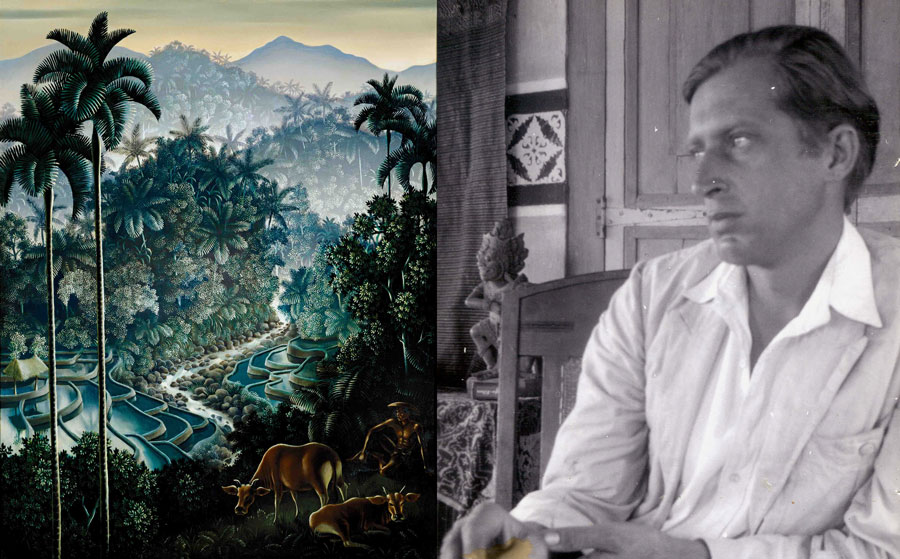
German artist Walter Spies settled in Bali in the 1920s and became one of the most influential Western artists working on the island. Based largely around Ubud, he developed close relationships with local artists and the Ubud royal family, introducing new ideas around perspective, light and composition.
His influence helped encourage Balinese painters to experiment beyond established traditional styles while continuing to draw inspiration from mythology, nature and everyday life.
Rudolf Bonnet
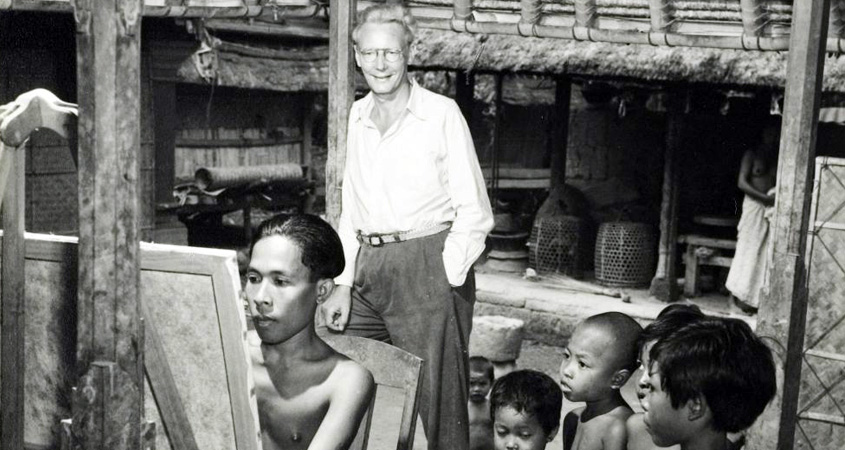
Dutch artist Rudolf Bonnet arrived in Bali in the late 1920s and became closely involved with the island’s developing art scene. Known particularly for his portraits, he worked alongside local artists and Walter Spies and later became a key figure in the Pita Maha artists’ collective.
Established under the patronage of the Ubud royal family, particularly Tjokorda Gde Agung Sukawati, with Bonnet acting as a chief consultant, the organisation helped support local artists and promote Balinese art to a wider audience.
Arie Smit
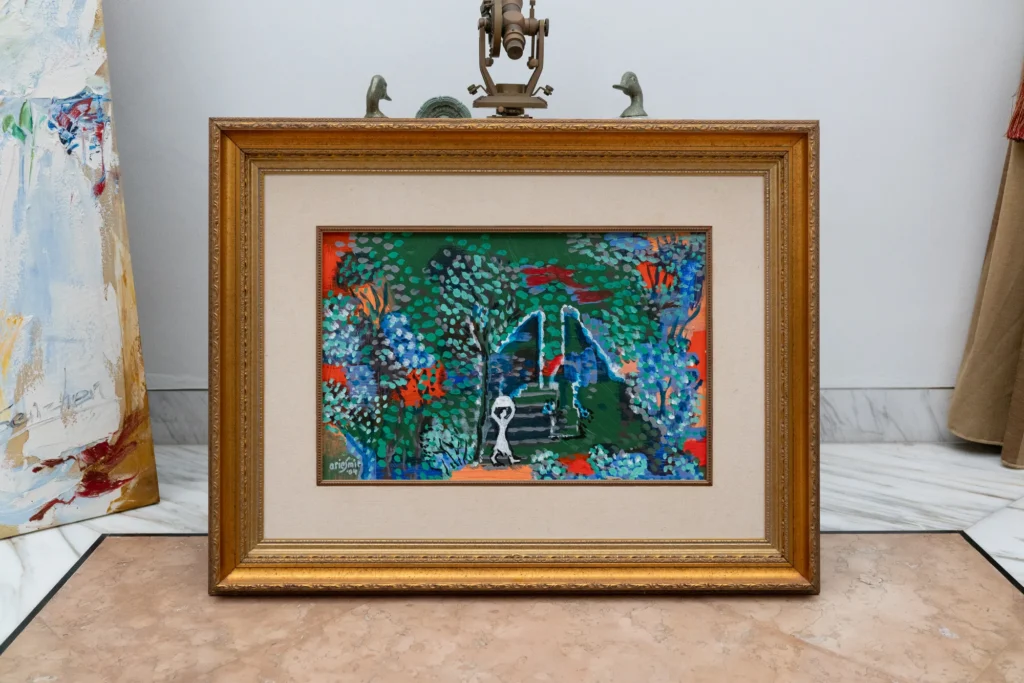
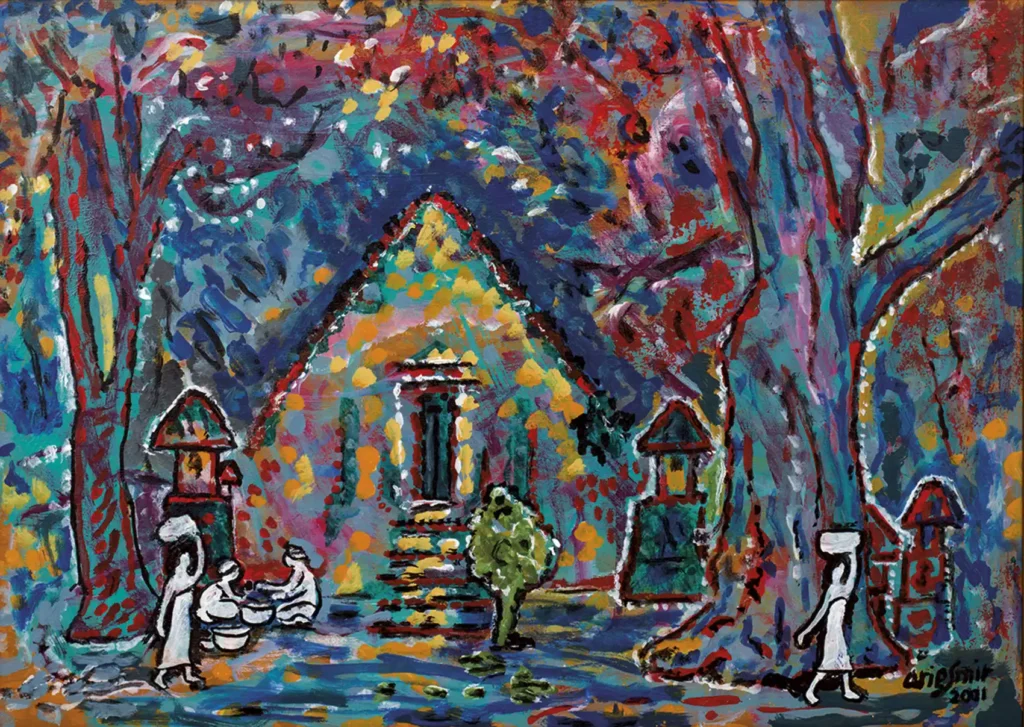
Dutch-born artist Arie Smit moved to Indonesia in the late 1930s and eventually settled in Bali, where he became an important influence on a new generation of local painters. In the 1960s, he began encouraging young artists around Ubud to experiment freely with bright colours and simplified forms rather than strictly following established traditions.
Their work became known as the Young Artist style, characterised by colourful, often playful scenes of village life, landscapes and everyday Bali. Smit continued living and painting in Bali for decades, becoming an important figure in the island’s modern art scene.
Other Western Influences
Spies, Bonnet and Smit weren’t the only foreign figures drawn into Bali’s creative scene. Swiss painter Theo Meier spent much of his life painting on the island, while Mexican artist Miguel Covarrubias documented culture through both his art and writing, describing the transformation of Balinese painting as a “liberating revolution” in his 1937 classic book, Island of Bali.
Anthropologist Gregory Bateson, working alongside Margaret Mead, also produced an extensive visual record of Balinese life during the 1930s.
The Main Styles Of Balinese Painting
As Balinese artists began experimenting with new materials and Western influences, several distinctive schools of painting and modern art styles developed across the island. In particular, three villages, Ubud, Batuan and Sanur, became known for their own recognisable styles, while local art continued to draw on culture, religion and everyday life.
Ubud Style
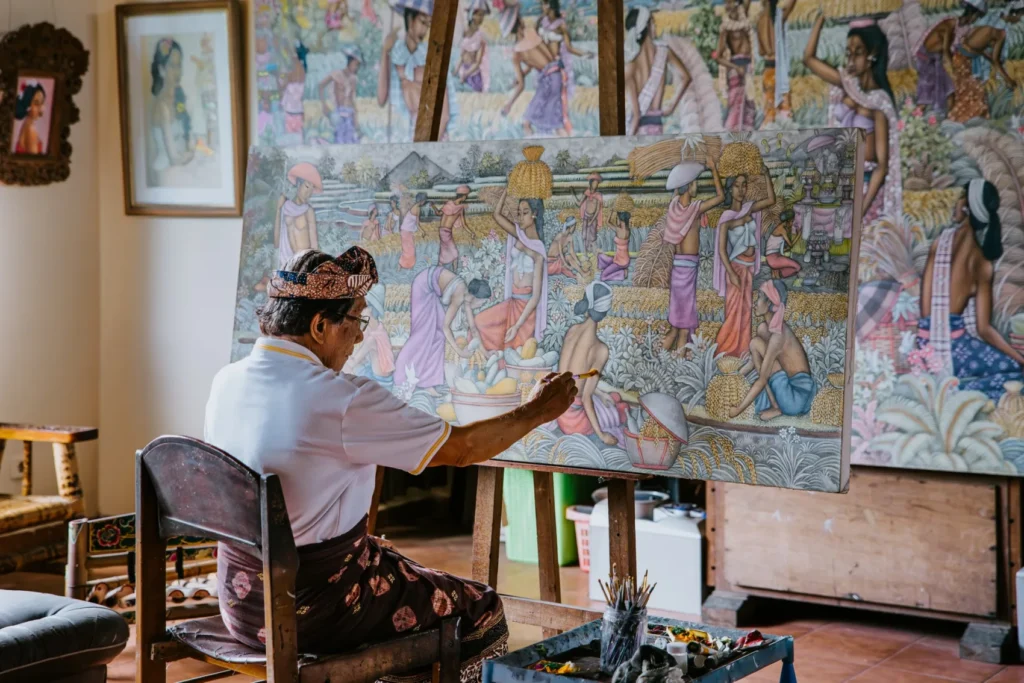
Ubud became the centre of a major artistic shift during the 1930s, when local painters increasingly combined traditional Balinese subjects with new techniques introduced through contact with Western artists. Paintings became more individual and experimental, with greater use of perspective, light and shade.


Artists continued to depict temples, ceremonies and rural life, but with more freedom in composition and style. Ubud remains at the heart of Bali’s art scene today, with museums, galleries and artists’ studios found throughout the area.
Batuan Style
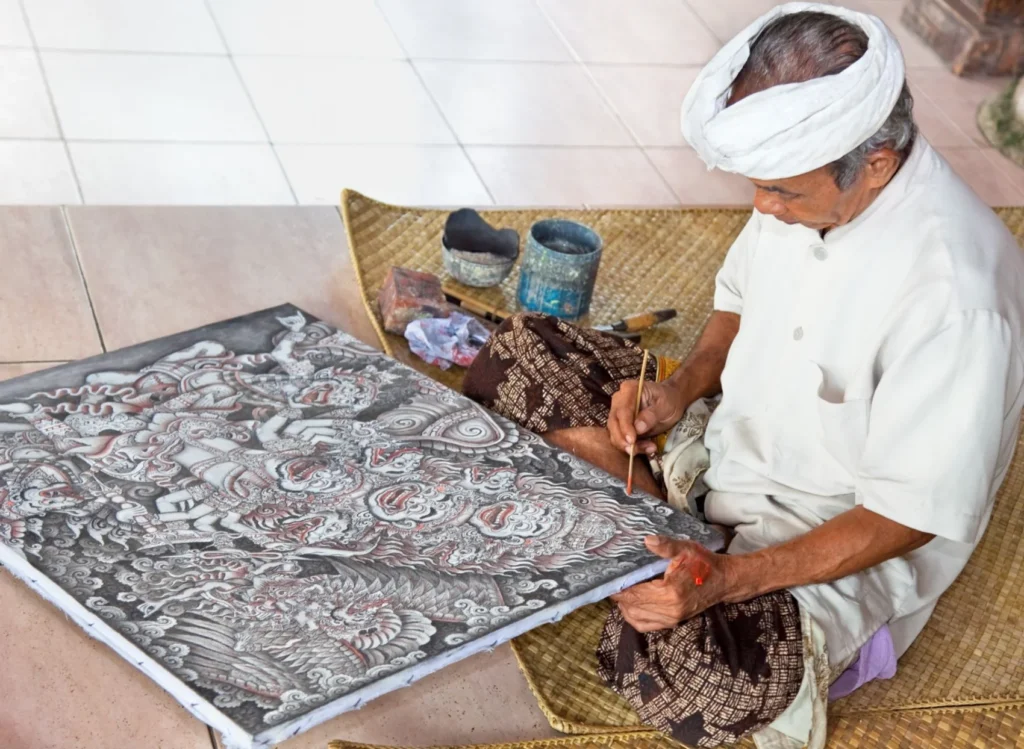
Originating in the village of Batuan, this distinctive style is known for its dark, densely packed and incredibly detailed images. Paintings often contain dozens of figures squeezed into elaborate scenes depicting mythology, ceremonies, village life and sometimes darker supernatural themes.
Traditional Batuan works tend to use restrained colours, with intricate layers of ink and shading creating an almost atmospheric quality. The more closely you look, the more minute details and hidden scenes you tend to notice.
Sanur Style
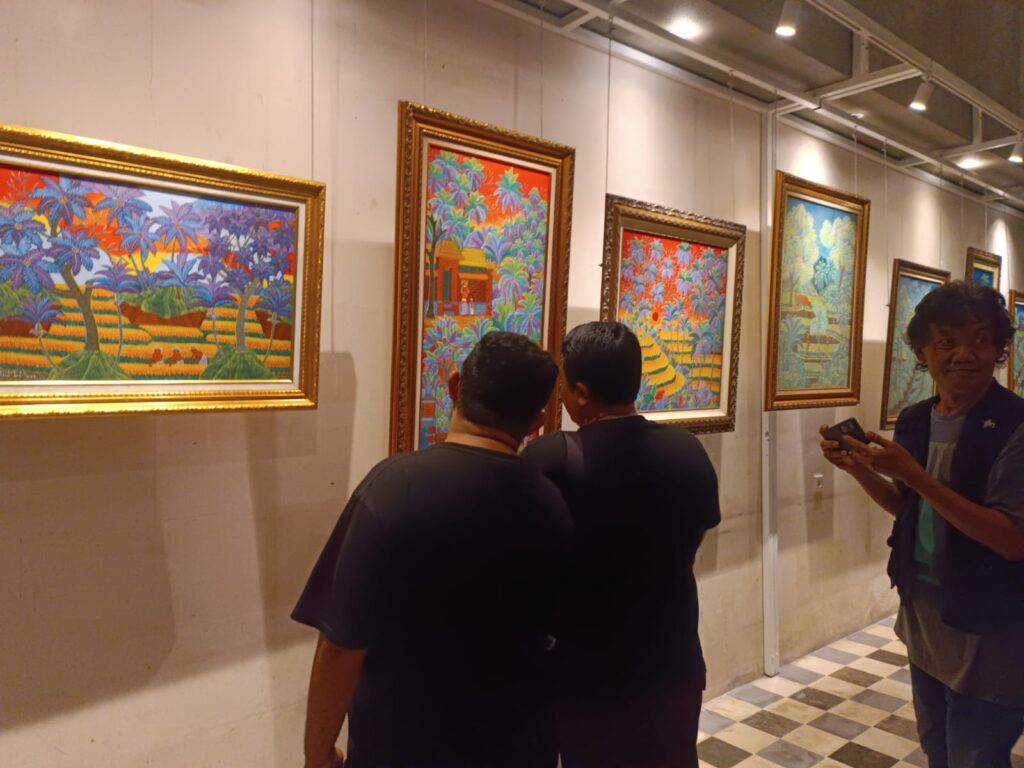
The Sanur style developed along Bali’s southern coast and took inspiration from a very different environment. Local paintings frequently depicted fishing, marine life, coastal landscapes and everyday village scenes, often with a lighter and more decorative feel than the dense paintings associated with Batuan.
Contact with foreign visitors and artists also influenced its development, including Belgian painter Adrien-Jean Le Mayeur de Mepres, who settled in Sanur and famously painted scenes inspired by Bali and his Balinese wife, Ni Pollok.
Young Artist Style
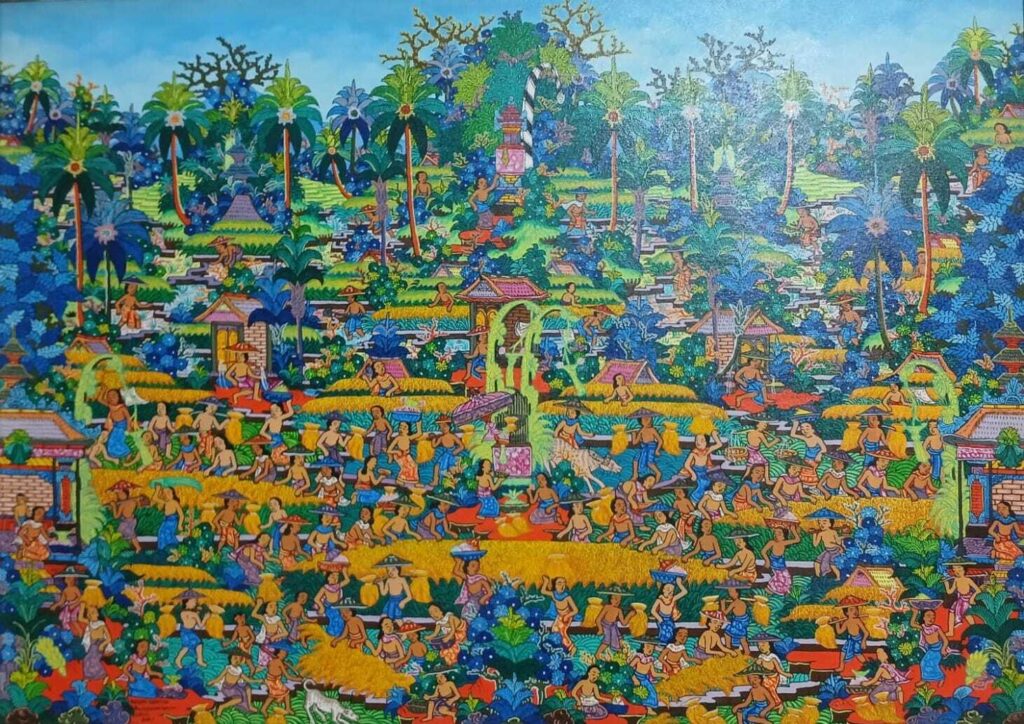
The Young Artist style emerged in the 1960s through the influence of Dutch artist Arie Smit, whom we mentioned earlier. He encouraged young Balinese artists to experiment freely with colour and composition.
The resulting paintings are immediately recognisable for their bright colours, simplified shapes and playful, almost child-like quality. Rural life remained a favourite subject, with rice fields, village scenes, animals and local people appearing frequently.
The movement became particularly associated with villages around Ubud and introduced another distinctive direction to modern traditional painting.
Keliki Miniature Painting
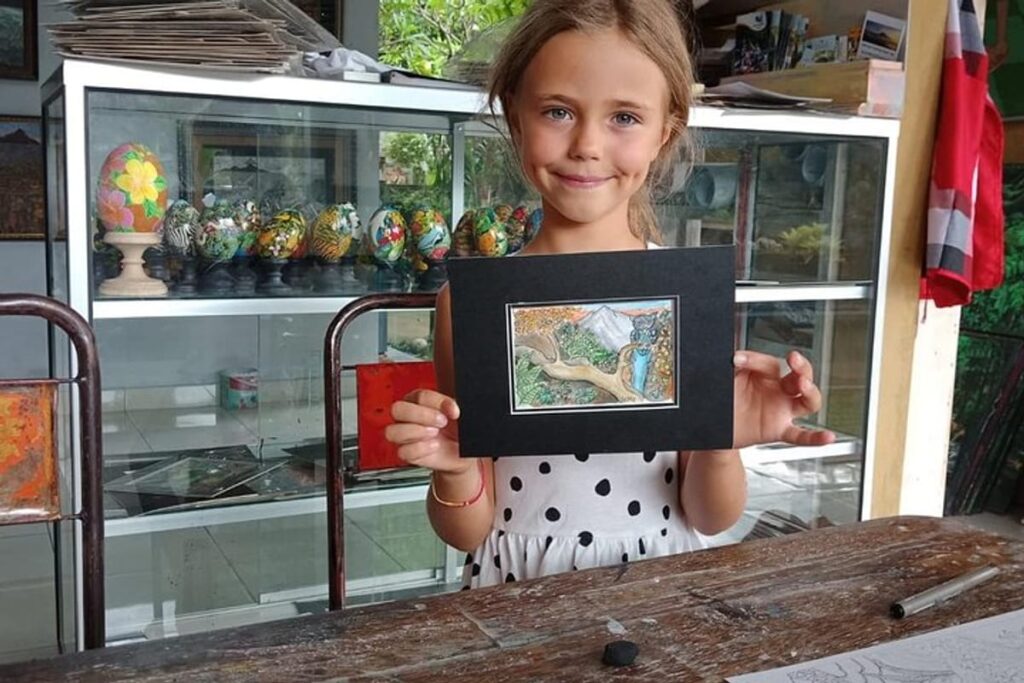
Named after the small village of Keliki north of Ubud, Keliki miniature painting takes Bali’s love of intricate detail to another level. The style developed further in the 1990s, when local farmer and artist I Ketut Sana helped drive a new movement towards increasingly detailed miniature works.
Artists create remarkably complex images on a very small scale, often depicting village life, landscapes, mythology and religious scenes filled with tiny figures and elaborate patterns.
Many works are produced using fine black lines with carefully added colour, and their small size means you often need to look closely to appreciate just how much detail Keliki artists manage to include.
Fingerprint Painting
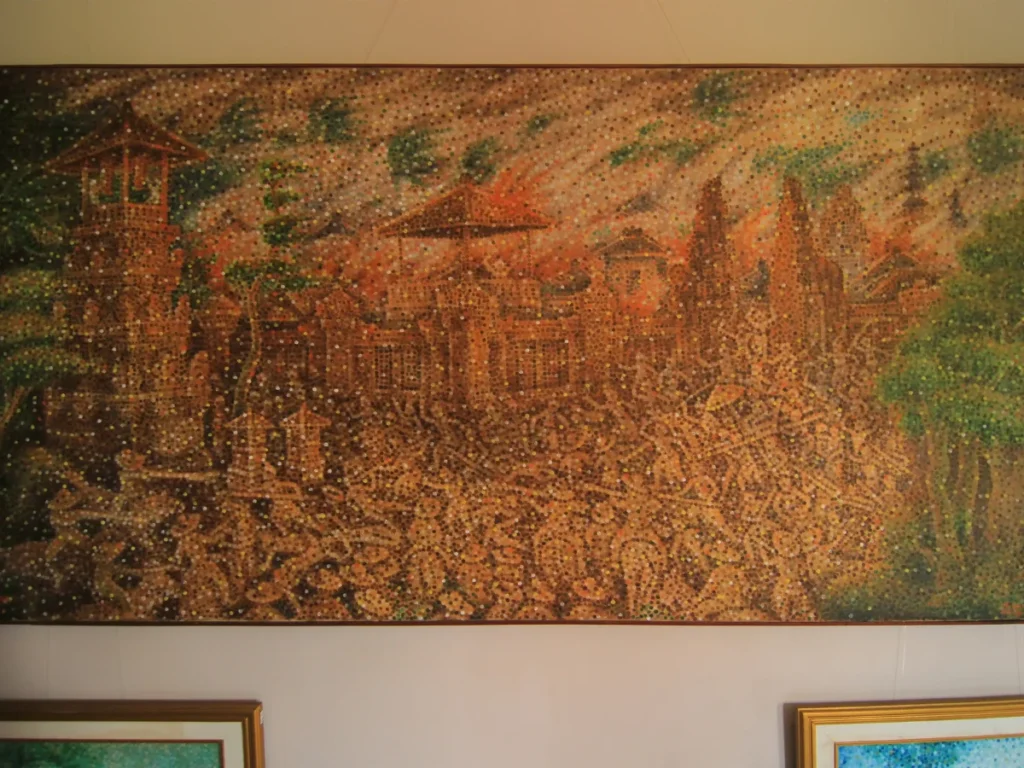
Fingerprint painting is one of Bali’s more unusual modern art forms. The technique is particularly associated with Balinese artist I Ketut Sana, who developed images by building up thousands of individual fingerprints rather than relying solely on conventional brush strokes.
Viewed from a distance, the prints combine to form complete figures and scenes; up close, the individual marks become much more apparent. It’s a striking example of how local artists have continued developing entirely new techniques rather than simply reproducing Bali’s older painting traditions.
Wood Carvings
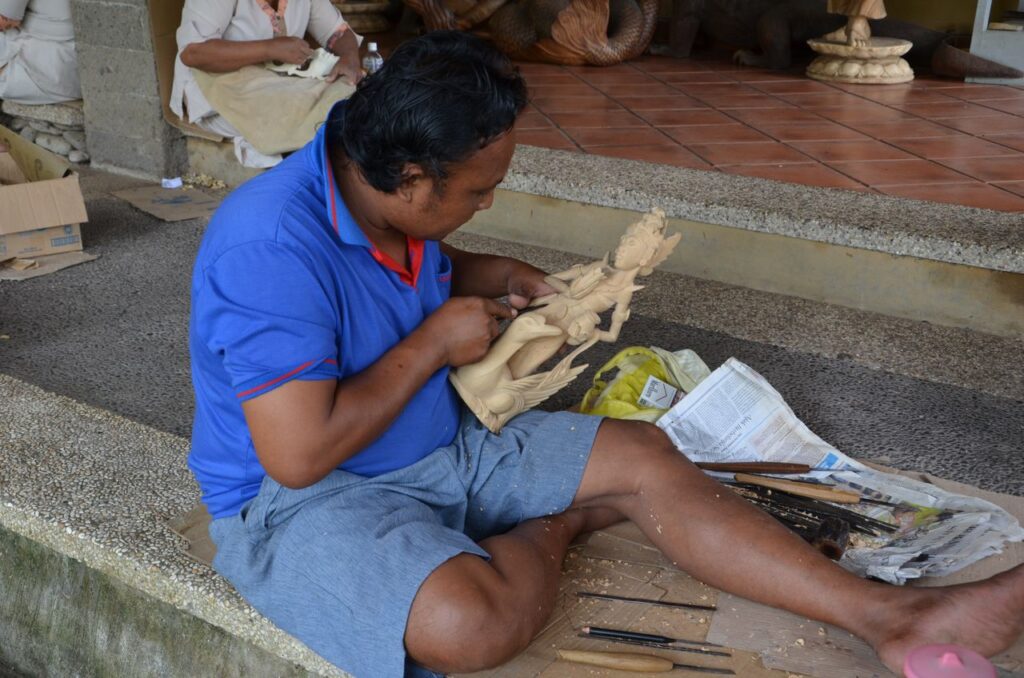
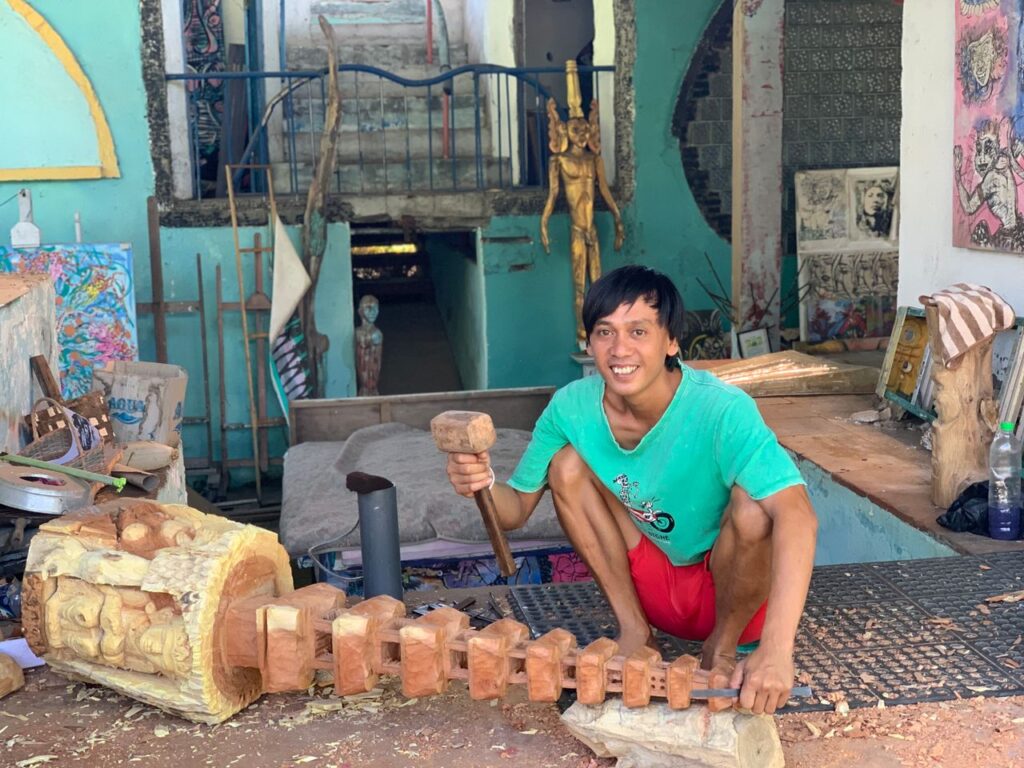
Wood carving is one of Bali’s most recognisable traditional art forms, with skills passed down through generations of artists. Carvings range from elaborate religious figures and scenes from Hindu mythology to animals, masks and modern decorative pieces.
Mas Village, near Ubud, is particularly famous for wood carving, with workshops and galleries found throughout the area. Balinese sculptors work with several local woods, choosing different materials depending on the size, detail and purpose of the finished piece.
Other Traditional Balinese Arts
Painting and wood carving may receive much of the attention, but Bali’s artistic traditions extend much further. Stone carving, metalwork and performance all remain closely connected to everyday life, religion and ceremony across the island.
Stone Carvings
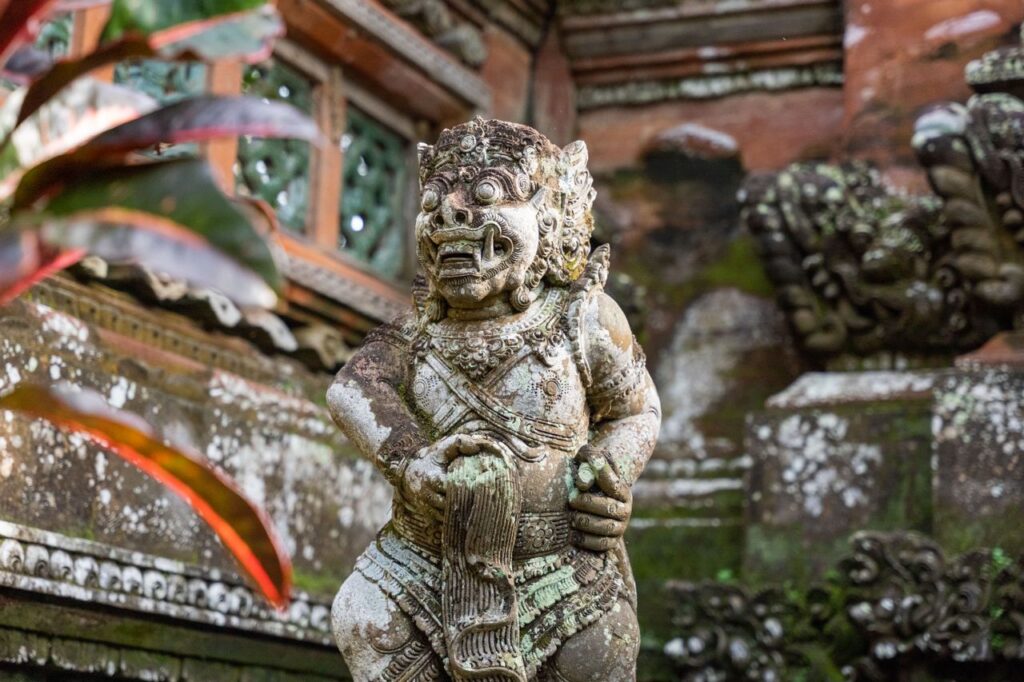
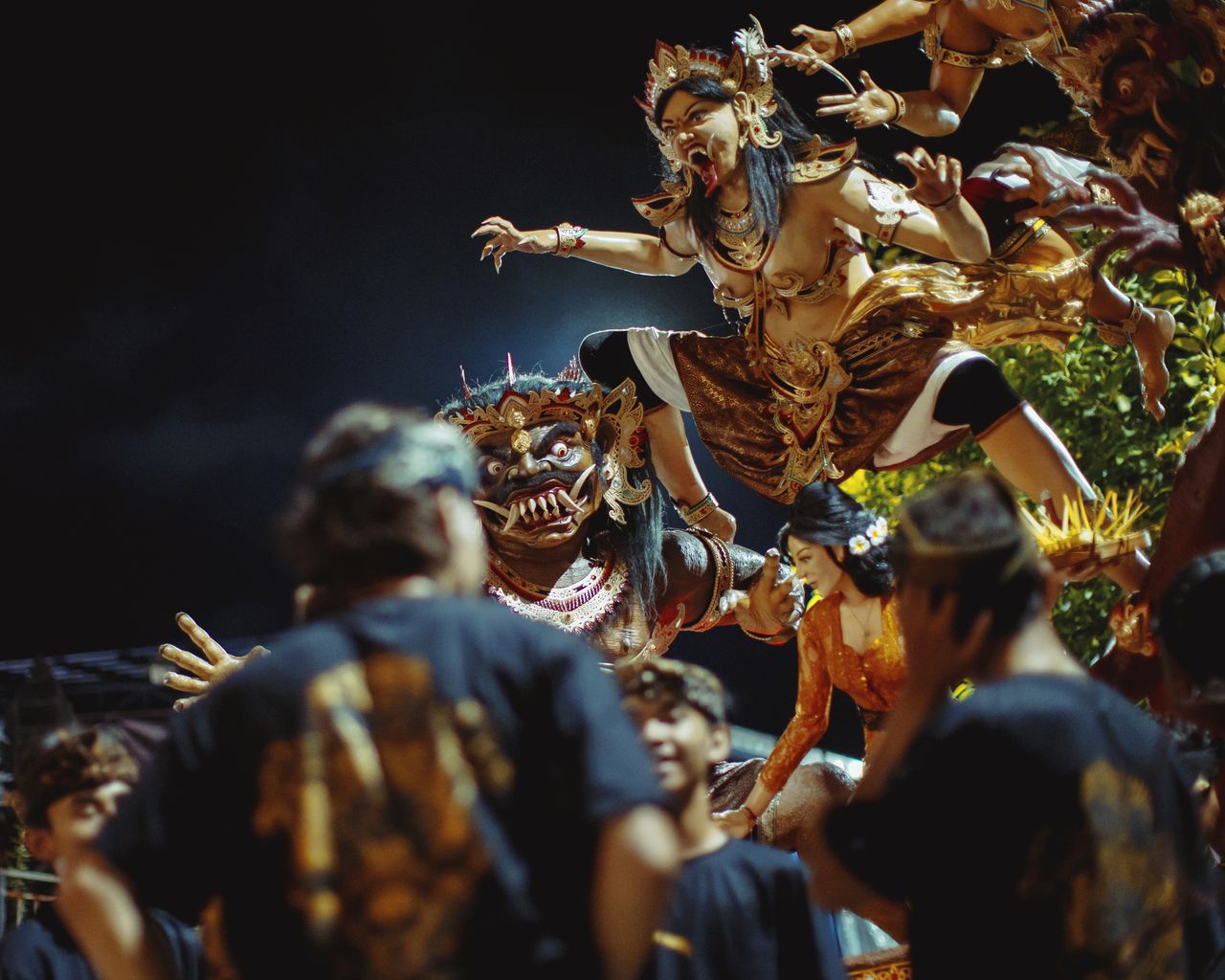
You’ll see the work of Bali’s stone carvers almost everywhere, particularly around temples, palaces and traditional homes. Intricate statues of Hindu gods, guardians and mythical creatures sit alongside decorative gateways and detailed reliefs.
Many are carved from the island’s volcanic stone, which explains the distinctive grey figures that seem to become part of the landscape as moss gradually grows across them.
Silversmithing
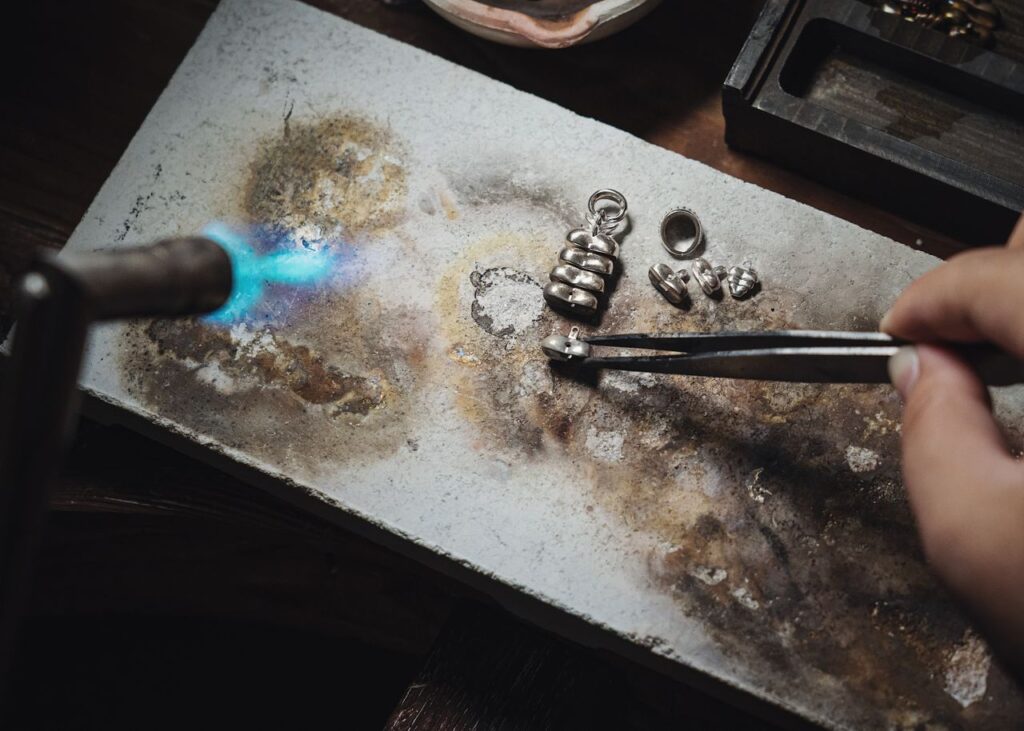
Bali also has a long tradition of silversmithing, with Celuk Village, south of Ubud, particularly well known for the craft. Local silversmiths create everything from intricate jewellery to ceremonial and decorative pieces, often using techniques passed down through generations.
You can visit workshops around Celuk to see artisans at work and buy pieces directly from local producers.
Balinese Dance
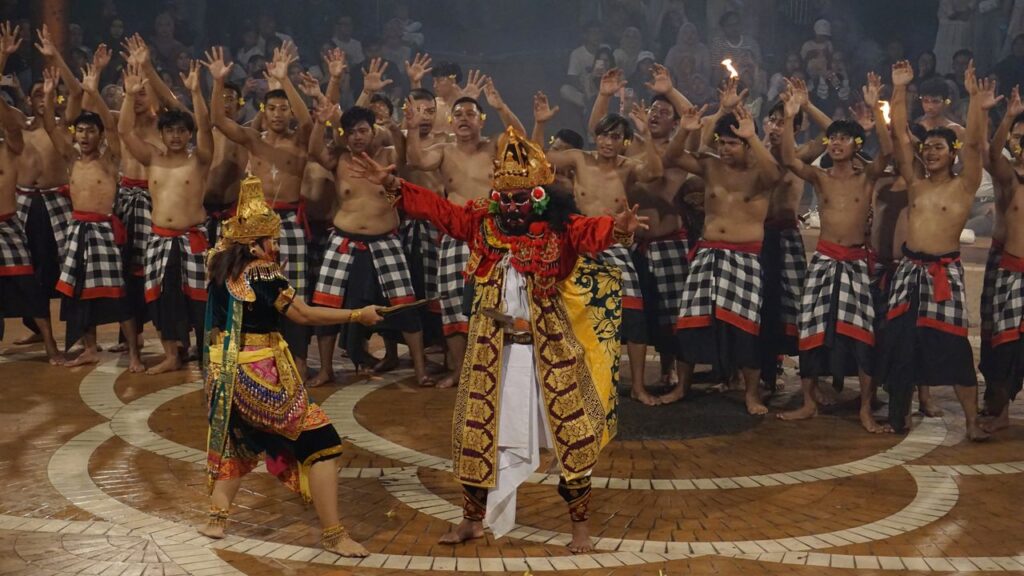
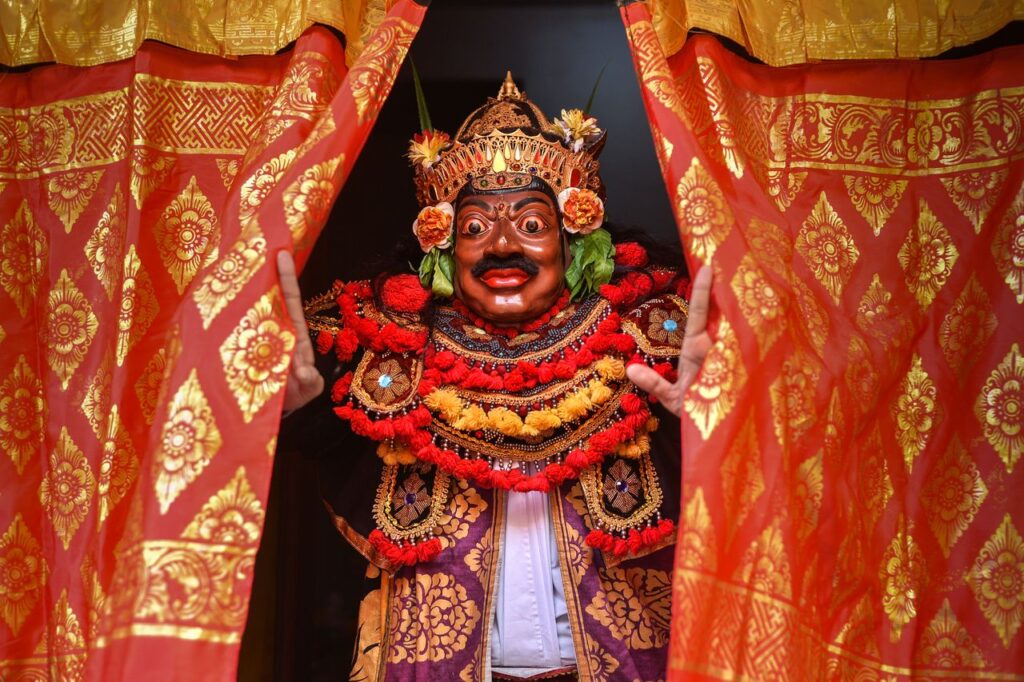
Balinese dance brings together movement, music, elaborate costumes and storytelling, making it as much an art form as a painting or sculpture. Many dances have religious or ceremonial origins, while others are now regularly performed for visitors.
Styles range from the refined movements of Legong to the dramatic battle between good and evil portrayed in Barong, while the famous Kecak uses a large chorus of chanting performers to retell scenes from the Ramayana.
Museums And Galleries In Bali
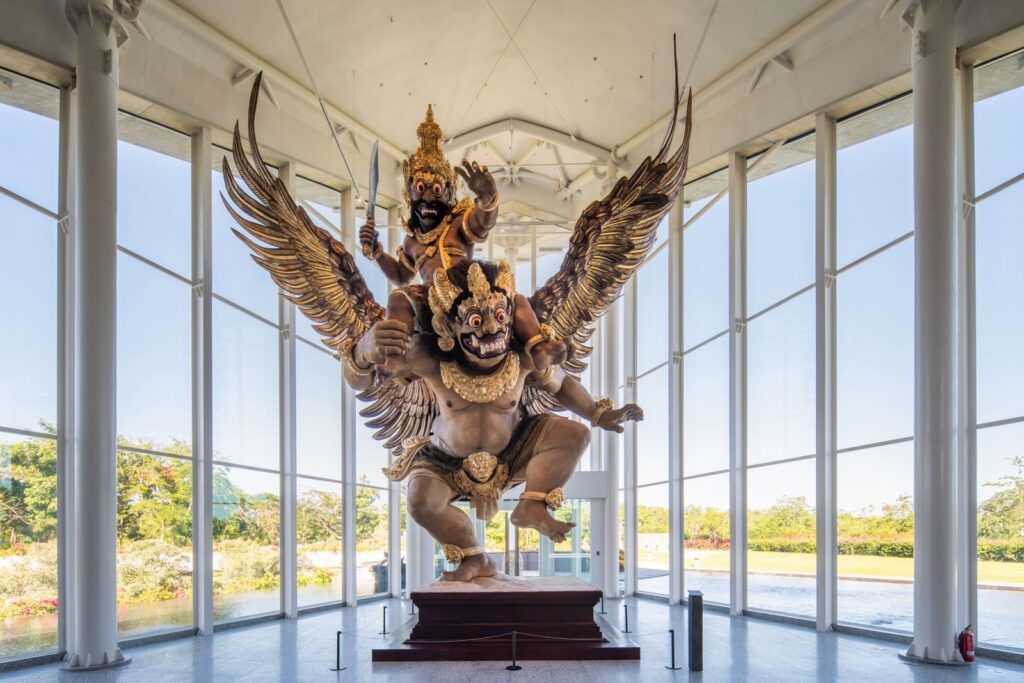
From traditional Balinese paintings to contemporary works, there are some excellent museums and galleries where you can explore the island’s artistic history. Ubud has the biggest concentration, but there are important collections elsewhere too.
- Neka Art Museum – One of Ubud’s best-known art museums, with a large collection tracing the development of Balinese painting through different periods and styles. You’ll find works by Western and Balinese artists, making it a useful place to see how outside influences helped shape modern Balinese art.
- Museum Puri Lukisan – Located in central Ubud, Museum Puri Lukisan focuses on Balinese painting and wood carving, with works spanning traditional styles through to more modern movements. It’s also closely connected to the development of Ubud as one of Bali’s major artistic centres.
- Museum Le Mayeur -Set inside the former Sanur home of Belgian artist Adrien-Jean Le Mayeur de Mepres, this smaller museum displays his paintings alongside personal belongings and the house where he lived with his wife, Ni Pollok. The setting itself is a big part of the experience.
- Agung Rai Museum of Art – Better known as ARMA, this Ubud museum combines traditional and contemporary Balinese art with works by influential foreign artists who lived or worked on the island. The collection is spread across attractive gardens and traditional Balinese buildings.
- SAKA Museum – Located at AYANA Bali in Jimbaran, SAKA takes a broader look at Balinese culture through art, heritage and carefully curated exhibitions. It’s a more contemporary museum experience, with changing exhibitions exploring traditions, ceremonies and creative life across the island.
Of course, this is only scratching the surface. There are hundreds of art galleries and dozens of specialised museums across Bali, covering everything from traditional paintings and sculpture to textiles, masks and contemporary art. There are far too many to list here, so wherever you’re staying, it’s worth seeing what you can find nearby.
FAQs
Where Do You Buy Wood Carvings In Bali?
You’ll find wood carvings for sale across Bali, but Mas Village near Ubud is particularly famous for its skilled woodcarvers and workshops. Ubud’s markets, galleries and craft villages are also good places to browse everything from small decorative pieces to large, intricately carved sculptures.
What Does Balinese Art Look Like?
Traditional Balinese art is often highly detailed, colourful and packed with figures, patterns and symbolism. Classic paintings frequently depict Hindu epics, mythology, ceremonies and scenes of rural life, although styles vary considerably between places such as Ubud, Batuan, Sanur and Kamasan. Modern Balinese artists have taken these traditions in many different directions.
What Wood Is Used For Carving In Bali?
Balinese artisans use several types of wood depending on what they’re creating. Common choices include suar, teak, mahogany, jackfruit and crocodile wood, with different woods chosen for their colour, grain, durability and how easily they can be carved.
How Would You Define A Classic Balinese Painting?
A classic Balinese painting typically tells a story rather than focusing on a single subject. Traditional works are often densely packed with figures and intricate details depicting Hindu-Javanese epics, mythology, religious ceremonies or everyday village life. The traditional Kamasan or Wayang style is one of the clearest examples.
Where Can I Find Balinese Art Outside Of Bali?
Balinese art can be found in museums and galleries around the world. Significant collections have made their way to institutions such as the Australian Museum, the National Gallery of Australia, the Asian Art Museum in San Francisco, the Ethnographic Museum in Leiden, and museum collections associated with Duke University Museum in Durham.
You can also find important collections elsewhere in Indonesia, particularly on the neighbouring Indonesian island of Java, including museums in Yogyakarta such as Museum Sana Budaya, Museum Bentara Budaya, and Gajah Gallery in Jakarta.
Final Thoughts On Balinese Art
Art has been part of everyday life in Bali for centuries, and you don’t need to spend long on the island to see just how deeply it remains connected to Balinese culture.
Visit a museum to understand its history, wander through the workshops and galleries around Ubud, or stop at a small studio and see local artisans at work.
Whether you leave with a painting, a hand-carved model, or nothing more than a few photos, exploring Balinese art offers another way to understand the island beyond its beaches and resorts.